
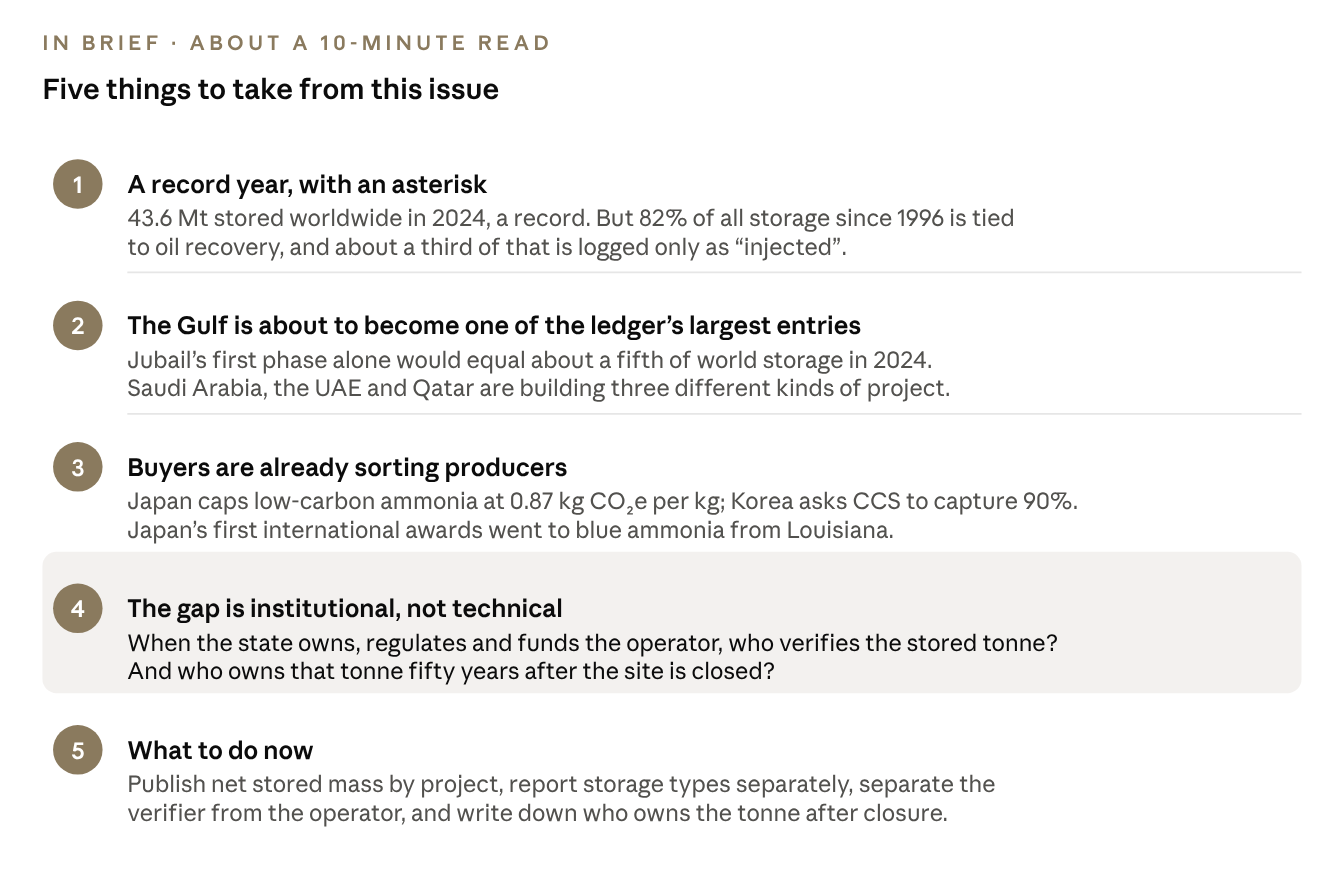
In brief.
Enlarge original chart ↗
Count what stays down.
The most important carbon number published this month was not a capture target. It was an accounting caveat.
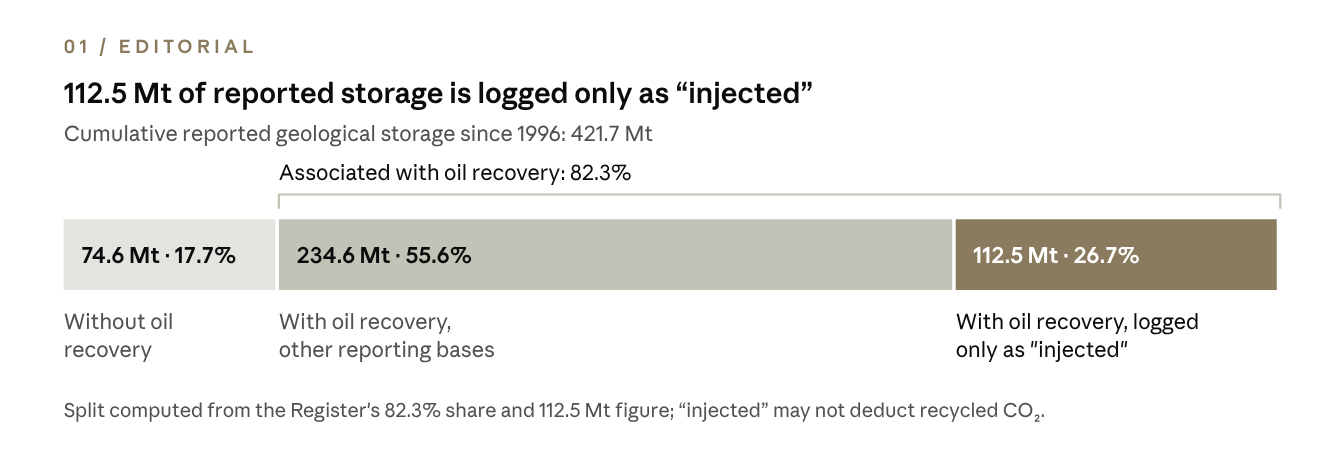
On 27 October, the London Register of Subsurface CO₂ Storage, led by Imperial College London, reported a record 43.6 million tonnes of CO₂ stored underground worldwide in 2024. The fine print matters more. The Register classifies 82.3% of all storage since 1996 as associated with oil recovery, and about a third of that, 112.5 million tonnes, is recorded simply as "injected", possibly without deducting CO₂ that comes back up with the oil and is reinjected. The authors have also revised their own earlier totals downward after correcting for recycled CO₂ and double counting.
Enlarge original chart ↗
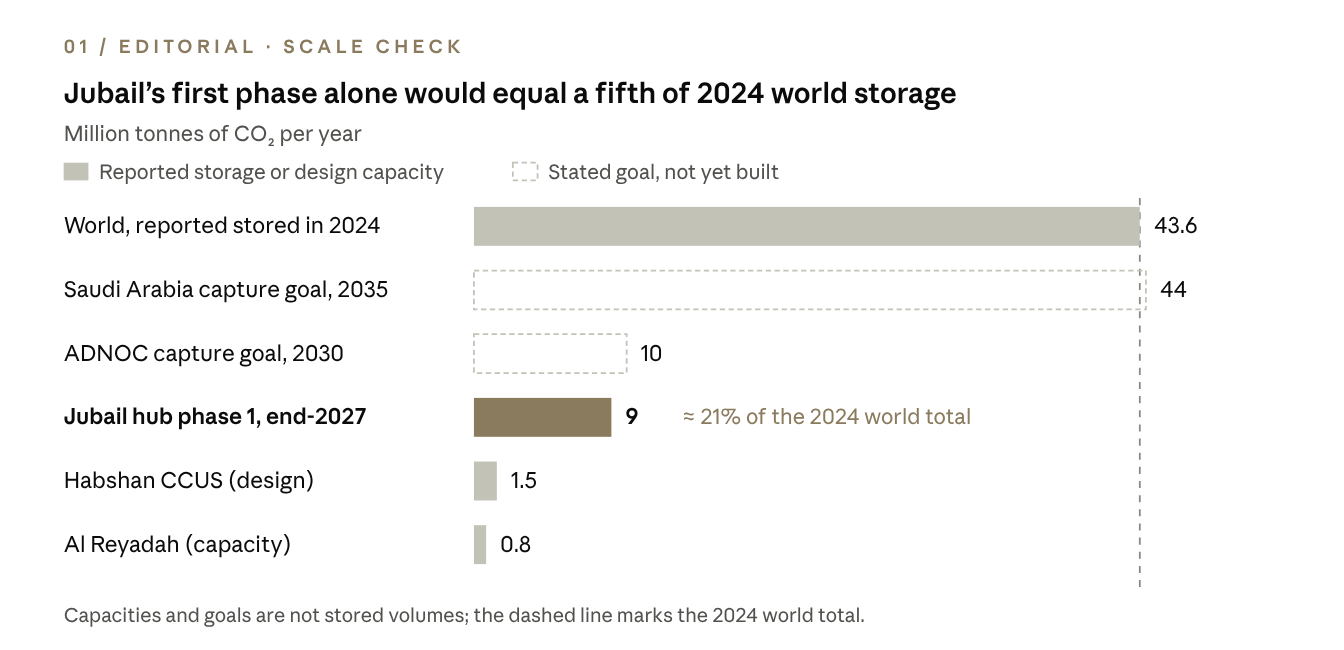
This matters here because the Gulf is about to become one of the ledger's largest entries. The first phase of the Aramco, Linde and SLB hub at Jubail is designed to store up to 9 million tonnes a year in a saline aquifer from the end of 2027: about a fifth of everything the Register recorded worldwide in 2024. ADNOC's Habshan project, at 1.5 million tonnes a year, will inject into ADNOC Onshore's Bab Far North field and, the company says, could support oil recovery, as its Al Reyadah facility already does. Saudi Arabia has a carbon capture target of 44 million tonnes a year by 2035; ADNOC targets 10 million tonnes of capture capacity by 2030.
Enlarge original chart ↗
Qatar adds a third model. QatarEnergy has operated capture capacity of up to 2.2 million tonnes a year since 2019, has hired Samsung C&T to build one of up to 4 million tonnes for its LNG production, and targets more than 11 million tonnes a year by 2035 (AGBI).
Three countries, three different products: dedicated storage, storage that recovers oil, and capture attached to gas exports. My concern is that they will be reported, and judged, as one "Gulf CCS" number, and that a buyer who cannot tell them apart will discount all three to the weakest.
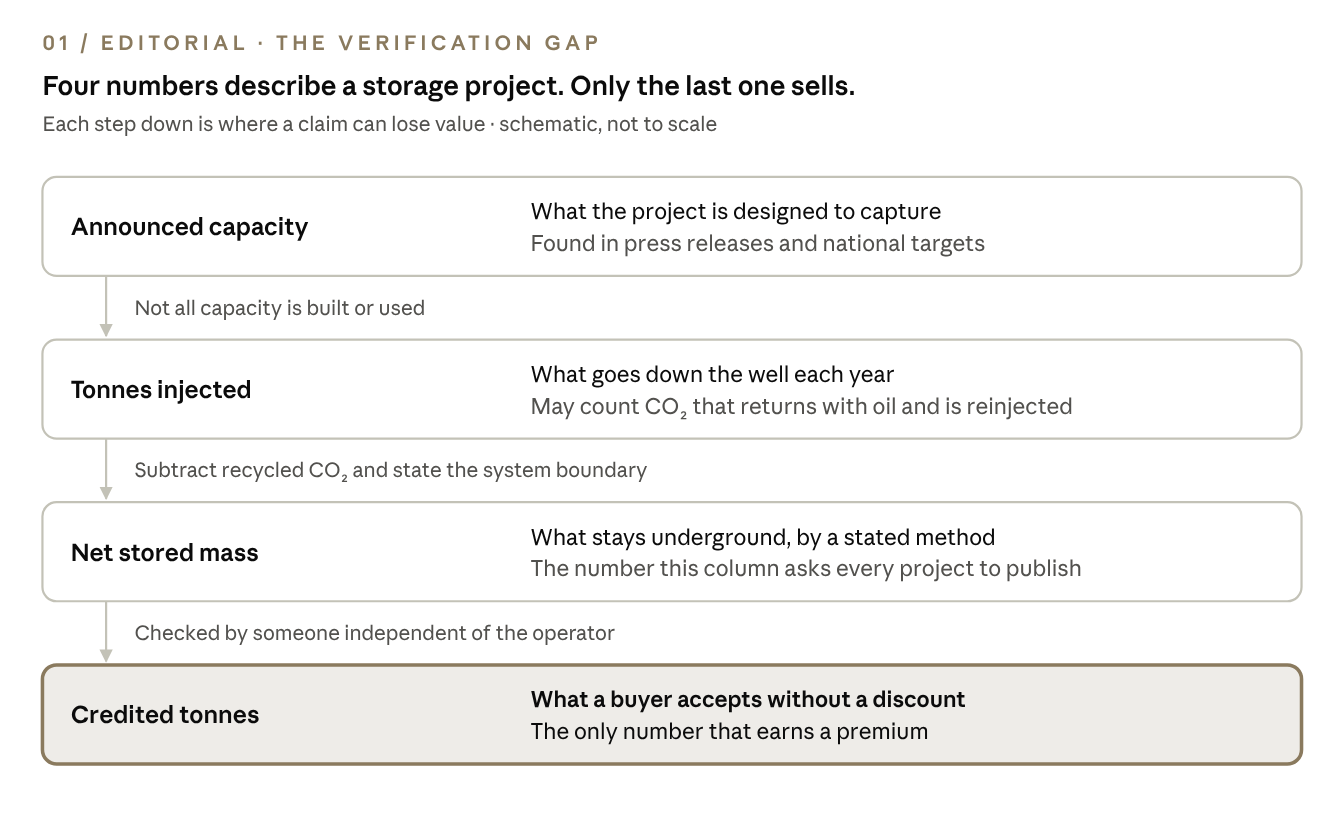
A stored tonne is not always an avoided tonne. When CO₂ is used to recover oil, that oil is burned. IEA analysis summarised by the Clean Air Task Force finds that, in a base case, about 63% of the CO₂ stored through enhanced oil recovery is a net reduction once the extra oil is counted, within a range of roughly 47% to 150% depending on which oil it displaces. That is a real benefit. It is not the same number as the tonnes injected, and a report that does not state its system boundary invites the buyer to assume the worst.
The United States has already decided how to count it. Its 45Q tax credit pays for storage through oil recovery only if the operator documents it under the EPA's Subpart RR reporting rules or the ISO 27916 standard, which requires a qualified independent engineer or geologist to certify the documentation each year (Congressional Research Service). With the EPA now moving to drop Subpart RR reporting, Treasury lets operators file that annual report with an independent engineer or geologist instead (Holland & Knight). The lesson for the Gulf is not to copy the subsidy. It is that the money followed the method, and the method carries an independent signature.
Enlarge original chart ↗
The harder question is who checks. In Europe and the United States, the stored tonne is generally checked by a regulator separate from the operator. In the Gulf, the state generally owns the national oil company, regulates it and funds its projects. Asking a ministry to make net stored mass a condition of support is asking the state to audit itself. In my view, that is exactly why independent verification matters more here, not less: it is the only way a buyer abroad can trust the number. The more ambitious route is for Gulf states to write a regional storage standard demanding enough that others adopt it. Someone will set these rules. The choice is whether the region writes them or is audited against them.
“Someone will set these rules. The choice is whether the region writes them or is audited against them.”
Then ask who owns the tonne in fifty years. Under the EU's CCS Directive, responsibility for a closed storage site passes to the competent authority only once all available evidence shows the CO₂ will stay permanently contained, normally after at least 20 years, and after the operator has paid at least 30 years' worth of monitoring costs (Directive 2009/31/EC). In the Gulf, the state already owns the operator, so that transfer is invisible, and so is its cost. I would want it written down before the first tonne is injected: who monitors after closure, who pays if CO₂ migrates, and where that obligation appears in the public accounts. Otherwise the liability simply passes to the next generation without anyone having decided it should.
The buyers are already sorting producers. The EU's Carbon Border Adjustment Mechanism, which began replacing free allowances in 2026 after a transition period, covers hydrogen and fertilisers (Clean Hydrogen Partnership observatory). But the larger buyers of Gulf blue ammonia are in Asia, and they are strict. Japan's low-carbon standard sets a well-to-gate ceiling of 0.87 kg CO₂e per kg of ammonia (S&P Global), and its first international awards, in January 2026, went to blue ammonia from Louisiana (Decarbon Fuse). Korea's clean hydrogen power auction required CCS projects to capture 90% of their emissions, a bar that, Argus reported, ruled out at least one Middle Eastern project (Argus). A producer that can show audited net storage will negotiate from strength. One that can show only capacity will, I suspect, be priced as a risk.
The commercial answer already exists elsewhere. Since December 2025, Norway's Northern Lights has issued its customers a storage certificate for each shipload of CO₂ it stores, including the emissions of transporting and injecting it. A stored tonne has become a product with a receipt.
My view. The Gulf's advantage in carbon storage is geology, and geology is not scarce: Norway and the United States already sell this service, and Malaysia is preparing to. What is scarce is a tonne that a Japanese utility, a European importer or a Korean auction will accept without a discount. The assumption that carries the region's blue ammonia business case is that buyers will credit its stored CO₂ in full. I would judge the region's carbon strategy not by its capacity announcements but by one test: how many tonnes can it certify each year, net, to a standard its customers already trust? On that measure, the public record does not yet show where the region stands.
“Geology is not scarce. What is scarce is a tonne a buyer will accept without a discount.”
The strongest counterargument is that oil recovery is how geological storage has scaled everywhere, and that project-level disclosure can expose sensitive reservoir data. Both points are fair. Neither requires secrecy about the one number that matters: the mass that stays underground each year, net of recycling, measured by a stated method and checked by someone independent of the operator.
What I would ask decision-makers to do:
- Publish net stored mass, project by project, with the monitoring method and the system boundary stated.
- Report dedicated storage, oil-recovery storage and capture for export separately, never as one total.
- Separate the verifier from the operator, through assurance the main export markets accept, or a regional standard built to that level.
- Write down who owns the stored tonne after closure, and what that obligation costs.
What would change my view: evidence that the main Asian and European buyers already accept current Gulf disclosures as they stand. The test is open to anyone. The Register's project database is public, and any ministry can check this week how its own projects appear in it.
The month, through
the same lens.
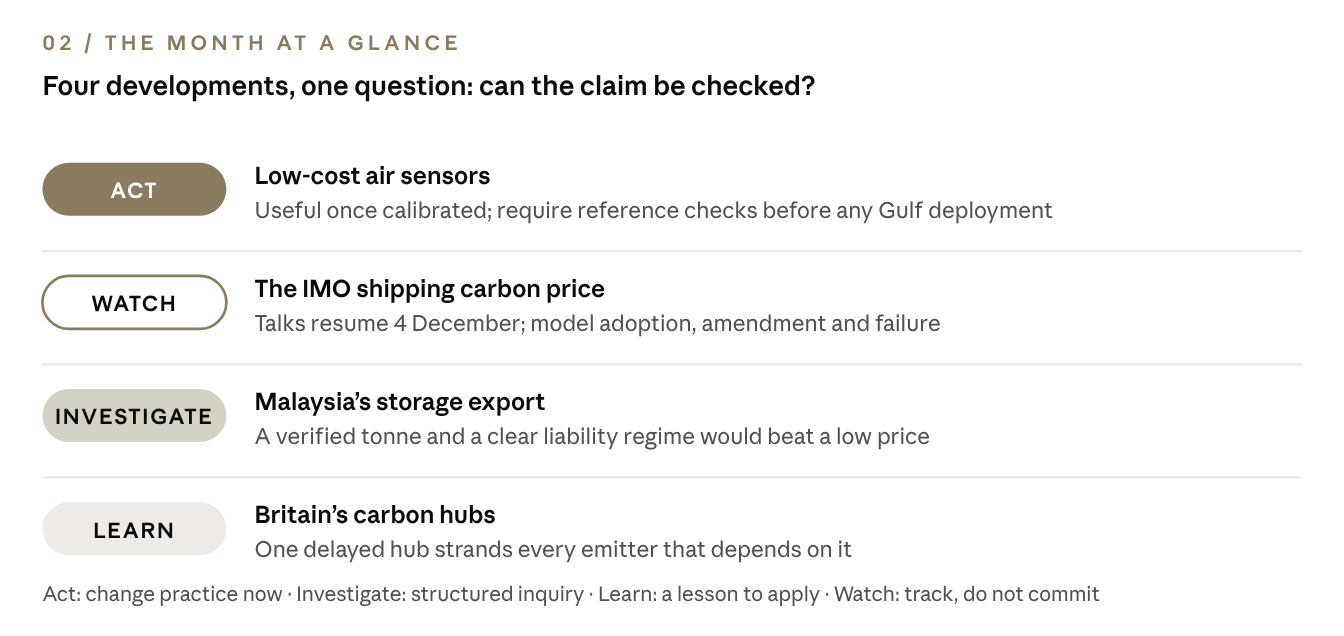
Four developments this month tested the same question in different places: can the claim be checked, and who does the checking? Each is graded by what the evidence supports today: Act, Investigate, Learn or Watch.
Enlarge original chart ↗
Cheap air sensors are useful, once someone checks them
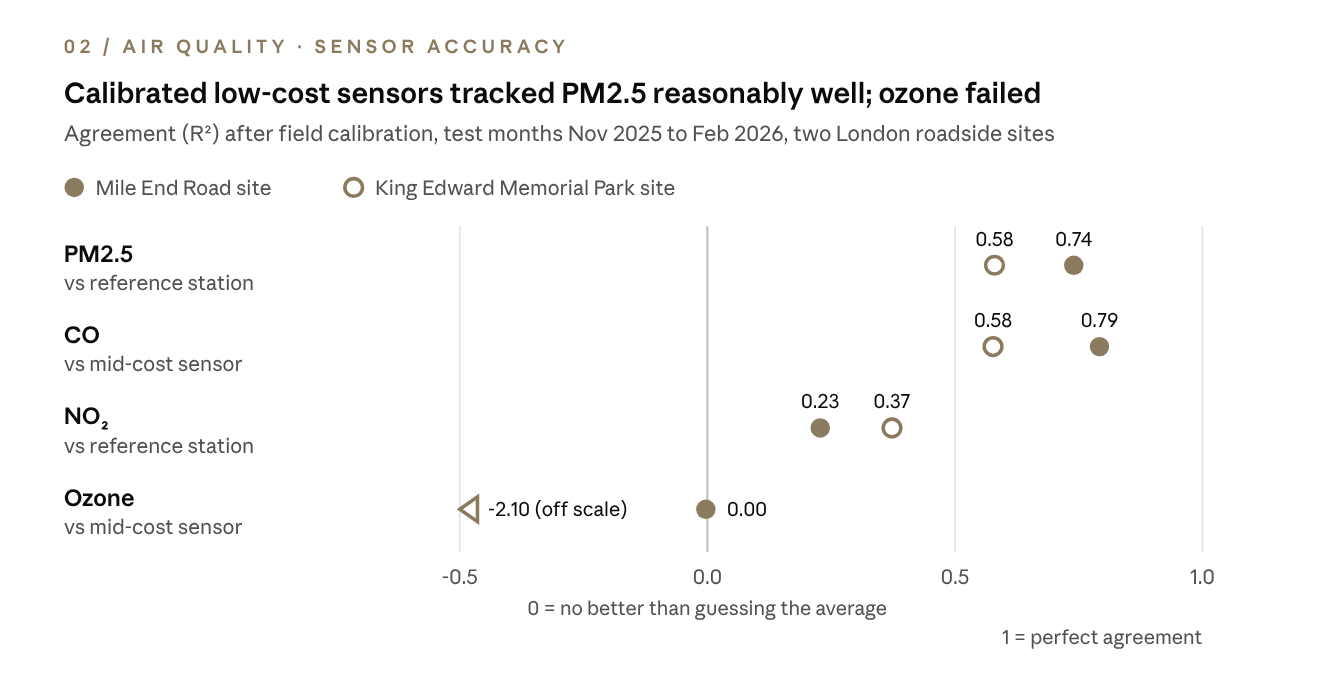
A 10-month study published in Sensors on 12 October, led by Queen Mary University of London, ran low-cost air monitors beside reference stations at two London roadsides. Once calibrated, the low-cost PM2.5 sensor tracked the reference reasonably well, and a simple linear correction for temperature and humidity worked as well as machine learning. The gas sensors were weaker: factory calibrations were unusable, CO worked only with machine learning and against a mid-cost sensor, NO₂ calibrations degraded as winter set in, and the ozone sensor failed. A low-cost node costs under US$200; a reference station about US$27,000.
Enlarge original chart ↗
The Gulf question is who relies on these numbers. School operators decide whether children play outside on a dusty morning. Municipalities publish city air maps. Employers plan outdoor shifts: the UAE bans outdoor work in direct sun from 12:30 to 3:00 pm between 15 June and 15 September (Gulf News). Yet Gulf heat, extreme humidity and desert dust are conditions the London study did not test. And much of daily life in Gulf summers happens indoors, where monitoring is thinner still. Buyers can act now: no sensor network without co-location against a reference station, seasonal recalibration and published agreement statistics. That standard applies to Amanah's partners too.
My view: the region should treat air data the way it treats financial data, with no published number without a stated method and an independent check. The people who carry the risk of a bad reading are not the vendors who sell the sensors. They are the outdoor worker and the child in the playground.
The shipping carbon price, and a Saudi paradox
The International Maritime Organization's Net-Zero Framework would combine a fuel standard with a global price on shipping emissions. In October 2025 it was not adopted: a motion to adjourn, put to a vote at Saudi Arabia's request, passed 57 to 49 with 21 abstentions. Talks are scheduled to resume on 4 December, and Japan has proposed removing the framework's Net-Zero Fund, which critics say would weaken climate finance for vulnerable countries.
The paradox is that the framework would create demand for the low-carbon ammonia and hydrogen Saudi Arabia is building to export. In my reading, the vote protected today's fuel market at the expense of tomorrow's, and it need not be the kingdom's last word. The draft framework measures fuels on a well-to-wake basis (BIMCO); if that survives, ammonia sold to ships will need the same documented upstream, stored CO₂ included, as ammonia sold to Japan. Exporters and ports should model adoption, amendment and failure rather than bet on one.
The risk is asymmetric. If the framework fails, Gulf producers keep today's bunker market for a while longer. If it passes later in a form the region did not help shape, they will sell their new fuels into rules written by others. That second outcome seems to me the more expensive one.
Malaysia turns storage into an export
On 23 October, Petronas CCS Ventures, TotalEnergies and Mitsui agreed to form a joint venture to store CO₂ offshore Peninsular Malaysia, starting with a depleted gas field of up to 5 million tonnes a year. First injection is now targeted for as early as 2031, against 2029 expected in 2024, and Japanese engineering studies have examined shipping CO₂ from Japan to Malaysia for storage. No final investment decision has been taken.
For the Gulf's storage-rich producers, the lesson is that a storage service sells one product: the verified tonne. Taking Asian emitters' CO₂ would also mean the state accepting liability for foreign carbon for centuries, a decision that binds future generations as much as today's balance sheet. That deserves a structured study, not an announcement.
I would not try to beat Malaysia on being first. I would compete on being trusted: a storage offer with Northern Lights-style certificates and a published liability regime is harder to copy than a low price.
Britain: a hub is only as strong as the trust in it
The UK Budget on 28 October left a £200 million commitment to Scotland's Acorn project unclear until a minister restated it the next day; SSE says its planned Peterhead gas plant depends on Acorn. In England, Cheshire West and Chester council formally opposed the Peak Cluster pipeline for cement and lime plants in May. Gulf hubs are unlikely to face council votes. Their equivalent risk is whether third-party emitters trust that a hub will be ready, fairly priced and transparently reported. Developers should publish connection terms early: uncertainty is a cost the emitter carries.
What does transfer is the dependency. One delayed hub strands every emitter planning to connect to it. An emitter whose decarbonisation plan rests on Jubail or Habshan should be able to answer a simple question: what is the fallback if the hub is late?
Also noted
- Gas processing is often the cheapest place to start. Ozona CCS and Marubeni took a final investment decision on the Pawnee project in Texas, about 400,000 tonnes a year from a gas treating plant.
- Ship-based capture needs a chain of custody. ClassNK's new handbook says credible claims depend on measurement, chain-of-custody tracking through offloading and emissions accounting, not on the capture hardware alone. Gulf ports would be natural offloading points.
- Brine-free solar desalination, still in the lab. A University of Rochester method turned ocean water into fresh water and solid salt with no liquid brine. Worth watching until it is tested on saltier Gulf seawater, in dust and summer heat.
The long view.
Read together, this month's developments say the same thing. The technology to capture, store or measure is no longer the hard part. The hard part is the institution around it: who measures, who certifies, who answers for the result in ten or fifty years, and whose rules the market uses. Those are political choices, and they land on people: the buyer who pays a premium, the worker who reads an air-quality alert, the citizen who inherits a storage site. My view is that verification is becoming infrastructure in its own right, as strategic for the Gulf as the pipelines and wells it describes. The region can build it, or rent it from others.
“Verification is becoming infrastructure in its own right. The region can build it, or rent it from others.”
What I am watching.
- COP31 in Antalya, 9–20 November: any decision on storage accounting or Article 6 trading that touches Gulf projects.
- IMO, 30 November to 4 December: MEPC 85, then the resumed session on the Net-Zero Framework, and how Gulf delegations vote.
- Habshan: confirmation of first injection, and whether ADNOC reports stored volumes separately from oil-recovery use.
- Jubail: construction milestones against the end-2027 target.
Sources and method.
- London Register 2026 Annual Report, as reported by chemeurope.com, 27 October 2026; Register site and database
- Jubail CCS hub: Arab News; JPT; OGCI CCUS Hub. Saudi 44 Mt/yr carbon capture target: Arab News
- Habshan CCUS: ADNOC Gas; Al Reyadah: MEED; ADNOC 10 Mt target: AGBI
- Life-cycle emissions of CO₂ enhanced oil recovery: Clean Air Task Force factsheet, citing IEA analysis
- Japan low-carbon ammonia threshold: S&P Global; first international CfD awards: Decarbon Fuse
- Korea clean hydrogen power auction: Argus
- Low-cost sensor study, Sensors 26(20):6441: PMC; UAE midday work ban: Gulf News
- IMO Net-Zero Framework: CIMAC; National Law Review; Cyprus Shipping News
- Malaysia Southern CCS Hub: Baird Maritime; The Edge Malaysia
- UK Acorn: ITV News; Energy Voice. Peak Cluster: Cheshire East Council; Cheshire West and Chester letter
- Pawnee FID: BIC Magazine; ClassNK: Carbon Herald; Rochester desalination: ScienceDaily
- QatarEnergy CCS: AGBI
- 45Q storage requirements, Subpart RR and ISO 27916: Congressional Research Service
- Northern Lights storage certificates: Northern Lights
- Transfer of responsibility for closed storage sites: Directive 2009/31/EC, Article 18
- 45Q safe harbour for annual reporting: Holland & Knight
- IMO draft framework, well-to-wake basis: BIMCO
- CBAM scope and phase-in: Clean Hydrogen Partnership observatory
Method note: this review is selective, not a survey. It covers items published or decided in October 2026, plus earlier research where it bears directly on them. Factual claims are checked against the sources listed by a reviewer independent of the drafting. Corrections are welcome and will be published.
Download the complete revised report ↓ PDF